


 Menu

To what extent should financial advisers encourage reluctant users of debt to jump on board? The question of how much debt people can comfortably afford, without compromising financial resilience, is an important one for financial advisers to consider.
For financial advisers, this raises another important question: when a client is strongly resistant to debt, is that simply a personal preference to respect, or could it prevent them from considering strategies that may help them achieve their long-term goals?
When insufficient debt is a problem
Let’s face it, no-one loves debt but most of us think of debt as a useful tool for wealth creation and liquidity management. Our research at Macquarie Business School is investigating the phenomenon of debt aversion. This appears to affect a significant minority of people. While the dangers of too much debt are obvious, insufficient debt can also be an issue. Some of the negative consequences include inability to pursue tertiary education, entrepreneurial activity, productive investments and even home ownership.
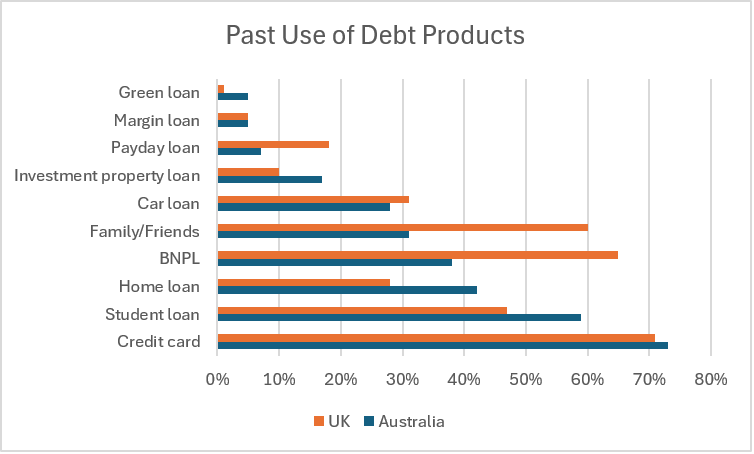
We investigated this issue by surveying younger adults (18-40) in Australia and the UK in mid-2025. We first asked about past use of debt products. Not surprisingly, the most used products were credit cards, student loans, home loans and buy-now-pay-later (BNPL). The latter is used more widely in the UK context. It’s worth noting that credit cards are not necessarily used as a debt facility; many users pay off the full balance each month.
For advisers working with younger clients, these findings suggest that assumptions about attitudes to borrowing shouldn’t be made simply because a particular strategy appears financially appropriate. Understanding how a client feels about debt may be an important part of the discovery process.
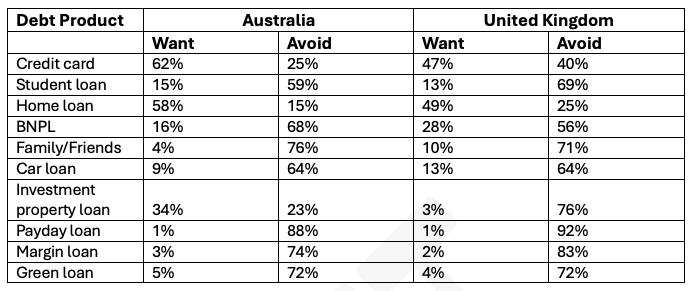
We next asked about future intentions with the options being a) want to use or keep using, b) neutral/not sure or c) avoid using. In Australia the most popular products are credit cards and home loans. It will be interesting to see if credit cards retain their popularity following recent legislation on credit card surcharges. Many card providers are cutting back loyalty programs as a consequence of these changes.
It is not surprising that most people want to avoid high-cost debt products like payday loans. But we were surprised at the high proportion of people wanting to avoid green loans and margin loans. It’s possible that these products were not familiar to the research participants and this is a contributing factor. Green loans are financing programs, often subsidised by the government, to encourage take-up of solar panels, batteries, electric vehicles etc.
Mortgages have traditionally been considered a socially acceptable pathway to home ownership – assumed to be a near universal goal. It is surprising to see that 15-25% of younger adults do NOT want a home loan and 23-76% do NOT want an investment property loan. This is consistent with some previous qualitative research we did that found debt aversion is contributing to lower rates of home ownership. Naturally we delved further to understand what is going on here.
Future intentions
It’s clear from our research that attitudes to debt vary considerably. An important consideration is the function of the debt. In general people have more favourable attitudes to debt for wealth creation and home ownership than they do for liquidity management. Even in the case of debt for wealth creation and home ownership, opinions vary widely.
One of the most crucial underlying factors is social norms. Perceiving that debt use is socially acceptable greatly reduces the odds that you will want to avoid it. In the interview study we found evidence that these social norms are often linked to family values.
This may give advisers another useful avenue for client conversations. Exploring where a client’s views about debt come from, rather than focusing immediately on the financial merits of borrowing, may help uncover beliefs that are influencing their decision-making.
Another underlying factor is risk aversion. Debt is correctly seen by many as a dangerous tool. People worry about their ability to control and manage debt. In the current environment where home prices are high and mortgages therefore large, the risks are magnified.
These concerns shouldn’t necessarily be treated as objections to overcome. They can instead provide a starting point for conversations about appropriate debt levels, buffers, insurance, cash flow and the client’s capacity to withstand financial shocks.
What to do with reluctant debt users?
Based on this research it’s highly likely that you will encounter reluctant debt users in your practice. For advisers, this means treating debt attitudes as part of understanding the client, rather than starting from an assumption that either using or avoiding debt is inherently the right decision.
- Try to understand what is driving debt reluctance. It could be a range of issues from bad past experiences, family values, lack of understanding of the role debt can play in wealth creation, genuine concerns about capacity to service debt and even religious beliefs (although this was quite rare in our research).
- Explore the risks. Where risk aversion is a driver, explore the risks the client is concerned about (e.g. unemployment, illness/accident, relationship breakdown, interest rates, property prices, inability to control discretionary spending). Also discuss the client’s financial resilience – ability to cope with a financial setback. This will be the topic of a future blog.
- Where appropriate, support the use of debt as a tool. Only if you are confident that the client can cope with the risks that debt creates, provide encouragement. This could involve further education about debt products and how to manage debt wisely. Given the importance of social norms, highlight the popularity of debt as a tool for people similar to them.
- The practical takeaway for advisers is not that clients should use more debt, but that attitudes towards debt can have a significant influence on the financial choices they are willing to consider. The next time a client rules out borrowing, it may be worth exploring why. Understanding the beliefs, experiences and risks behind that decision can help ensure the advice conversation considers both the opportunities and the risks of debt.
Want to know more?
Sheedy E, Wu T, Gao M (2026;), “Investigating debt aversion in younger adults”. International Journal of Bank Marketing, Vol. ahead-of-print No. ahead-of-print. https://doi.org/10.1108/IJBM-05-2026-0400
Sheedy E, McGrath V, Nguyen H (2026), “Debt aversion: causes and implications in younger adults”. International Journal of Bank Marketing, Vol. 44 No. 9 pp. 1978–2002, doi: https://doi.org/10.1108/IJBM-08-2025-0583
If you have questions about the research, please contact Professor Elizabeth Sheedy at the Macquarie Fintech and Banking Research Centre via email.
Professor Elizabeth Sheedy is an expert in household finance and risk management based in the Department of Applied Finance of Macquarie Business School. In 2021 she published her first sole-authored book entitled ‘Risk Governance: Biases, Blindspots and Bonuses’ with Routledge. She is an Associate Editor for the Journal of Banking and Finance – rated A* by the Australian Business Deans’ Council. Elizabeth teaches students in the MBA, Global MBA and M.Applied Finance programs.
Her current research focus is in household finance, with a particular focus on the financial decision making of young adults (housing, use of debt, financial resilience and wellbeing).